Forensic Firearm Identification Principle
The HollowThe Forensic Firearm Identification Principle is the rule that the marks made by a gun’s rifling can identify the particular weapon used to fire a bullet. Its decisive function in The Hollow is to separate appearance from material fact: Gerda Christow is found holding a revolver beside John Christow’s body, but the weapon in her hand is not the one that killed him. The principle therefore transforms an apparently self-evident murder scene into a problem of substituted weapons, deliberate misdirection, and concealed action.
Definition and Investigative Function
The principle operates through the physical marks left on a bullet by the barrel of a firearm. In the investigation, Inspector Grange initially treats the revolver recovered from the pool as an important object even though it has been left dripping wet and is unlikely to yield useful fingerprints. He nevertheless notes that this loss may not matter, because the weapon can be identified independently. Sir Henry Angkatell is expected to recognize whether it came from his collection, while the ballistic examination can establish whether it fired the fatal shot.
This distinction creates an evidence hierarchy within the case. The fact that Gerda Christow was holding a revolver when Hercule Poirot arrived is a powerful visual fact, but it does not prove that she fired the shot. The identity of the weapon, established through physical traces rather than through posture, testimony, or first impressions, carries the more decisive evidentiary force.
The Pool Scene and Its Contradiction
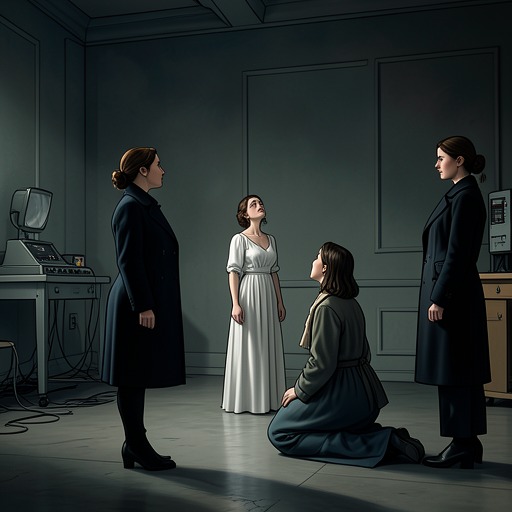
The principle becomes necessary because the scene beside the pool has been arranged like a theatrical tableau. John Christow’s body lies with an outflung arm, red paint has been allowed to drip over the concrete into the artificially blue water, and Gerda stands over him with a blank expression and a revolver in her hand. Around them, other people have arrived by separate paths: Henrietta Savernake and Edward Angkatell approach from the woods by different routes, while Lucy Angkatell comes from the farm path carrying a basket of eggs. The arrangement seems to offer a complete explanation, with Gerda visibly occupying the role of killer and the others positioned like witnesses.
The spatial reconstruction makes the tableau appear orderly, but its order is precisely what makes it suspicious. Poirot recognizes that the people have converged from different directions and that the whole image is artificial. The scene presents a man who appears to have just been shot and a woman who appears to be holding the gun she has just used; the firearm principle breaks that apparent unity. Once the weapon is shown not to have fired the fatal bullet, the scene is no longer a transparent record of an action. It is a set scene designed to make observers see one conclusion before the physical evidence forces them to revise it.
Discovery of the Wrong Revolver
Inspector Grange eventually tells Sir Henry that John Christow was not shot with the revolver Sir Henry identified that morning as belonging to his collection. This revelation changes the case immediately. The pool revolver is not merely an object with an uncertain history: it is the wrong weapon, placed where Gerda could be found holding it. The apparent confession supplied by her body and the weapon collapses under forensic examination.
The discovery also opens two competing explanations. The revolver may have been used to frame Gerda Christow, with the real weapon removed or concealed; alternatively, Veronica Cray might have shot John with her own gun and then taken a revolver from Sir Henry’s study to create confusion among the people at The Hollow. Inspector Grange observes that such a plan would require premeditation, since the killer would have to obtain a second weapon and rely on investigators’ ability to distinguish the guns.
Knowledge, Clues, and the Staged Explanation
The principle is not treated as an obscure technical secret. Sir Henry points out that many people might know about firearm identification because detective stories repeatedly use the idea. He specifically recalls The Clue of the Dripping Fountain, which John Christow had been reading on Saturday and which emphasized that police could determine which gun had fired a bullet. The forensic rule thus belongs simultaneously to professional investigation and popular crime fiction. It is a real scientific method, but it is also part of the characters’ imaginative equipment: a murderer can use knowledge acquired from detective stories to construct a false trail.
The resulting irony is central to the case. The murderer depends on the investigators first trusting the staged image and then being puzzled when the weapon fails to match the bullet. Gerda’s plan is built around that contradiction. She intends the authorities to find her holding one revolver, conclude that she fired the shot, discover that the bullet came from another gun, and then doubt that she was responsible. The false weapon is meant not simply to accuse her, but ultimately to help remove suspicion from her by making the first accusation technically impossible.
Confirmation and Final Reconstruction
The later telephone investigation provides decisive confirmation. Inspector Grange first reports jubilantly that the gun missing from Sir Henry’s collection is the gun that shot John Christow, and that it bears a good set of fingerprints, including a thumbprint, a first-finger print, and part of a middle-finger print. The material trail appears at last to connect the fatal weapon with a person. On the following day, however, Grange reports that the prints belong to none of the people connected with the case: not Edward Angkatell, David Angkatell, Sir Henry, Gerda, Henrietta, Veronica, Lucy, or even the kitchen maid. This result briefly revives the possibility of an unknown outsider who stole the guns, shot John, concealed the weapon, and escaped by the lane.
The final confession resolves the apparent contradiction. Gerda explains that Sir Henry had shown her how to load and fire a revolver that afternoon. She deliberately took two weapons, shot John with one, hid the real gun, and allowed herself to be discovered holding the other. Her plan depended on the forensic principle: the police would see the wrong revolver in her hand, then discover that it could not have fired the fatal bullet, and conclude that she had not killed John. She had even read about the method in the detective story. The overlooked holster in her bedroom supplies an additional physical trace of the plan, showing that the arrangement required more than a spontaneous act at the pool.
For Hercule Poirot, the firearm evidence explains why the murder scene felt artificial from the beginning. He recognizes that Gerda’s blank, theatrical manner was not simply the bewilderment of an innocent woman who had found John dead; she was acting a part within a deliberately prepared scene. Henrietta Savernake and the Angkatell family then help preserve the intended interpretation by protecting Gerda from the consequences of what she has done. The principle has therefore done more than identify a weapon: it has exposed the difference between a visible performance and the concealed sequence of shooting, hiding, substitution, and staging that produced it.